
Parking Guidance System in Pakistan Turn Every Parking Space Into an Intelligent Space.
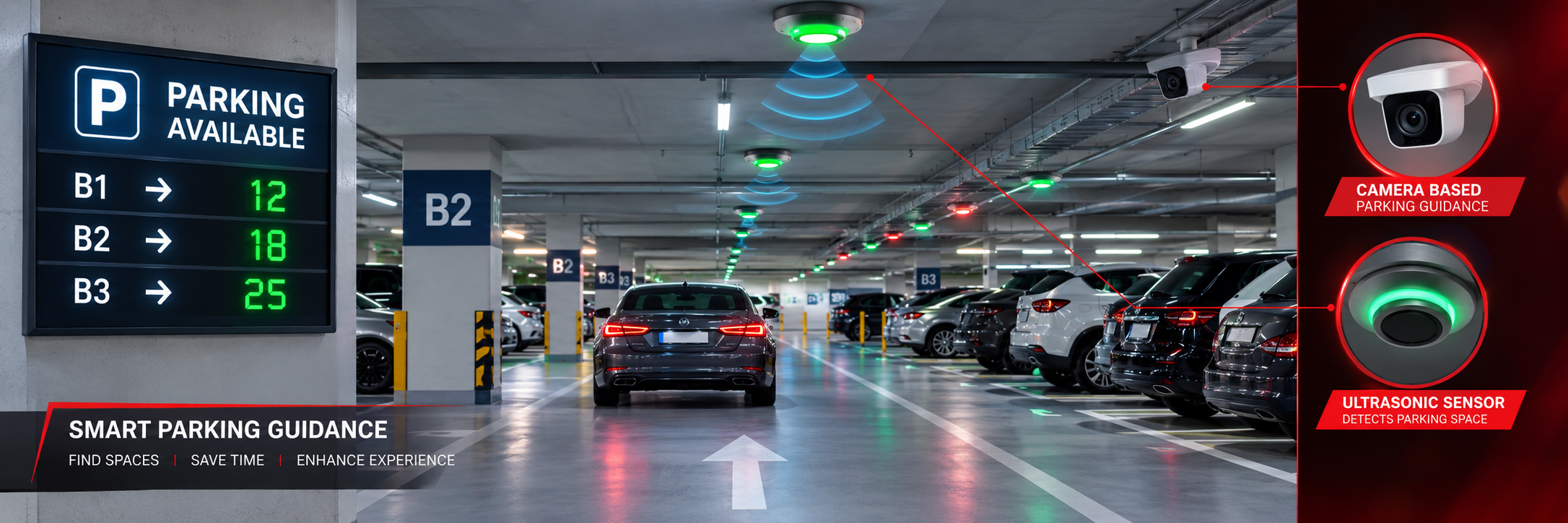
ASG Systems designs and installs smart parking guidance systems that detect every free bay in real time and lead drivers straight to it with LED bay indicators and live directional displays, for malls, hospitals, airports, offices and residential towers across Pakistan.
Find. Guide. Park.
- Since 1997
- Free site survey
- Nationwide support
- Ultrasonic and camera-based bay detection
- Basement, multi-level and open-air car parks
- Works with barriers, ANPR and CCTV
- Survey, design, installation and support by one team
What is a parking guidance system?
A parking guidance system (PGS) is a network of sensors, LED bay indicators, directional displays and software that shows drivers exactly where the free parking spaces are. Instead of circling ramps and aisles, drivers see how many spaces are free on each level the moment they enter, follow the displays to the right aisle, and spot the green light above an empty bay.
For owners and operators, the same system becomes a live picture of the whole car park: which bays are in use, when the peaks happen and how long vehicles stay. That data helps you use every space you already have before you think about building more.
In Pakistan’s busiest shopping malls, hospitals and commercial plazas, peak-hour parking is often the first and last impression a visitor has. A smart parking system turns that moment from frustration into a smooth, predictable arrival.
A parking guidance system detects whether each parking bay is free or occupied, shows real-time availability on displays at entrances, ramps and aisles, and guides drivers to the nearest free space with red and green LED indicators.
- 1Ultrasonic sensorMeasures the distance to the bay below.
- 2LED bay indicatorGreen when free, red when occupied.
- 3Directional displayShows free spaces and which way to go.
- 4Parking softwareCollects every change and builds reports.
How a parking guidance system works
Watch one arrival from the entrance to the bay. The same thing happens for every driver, every time.
- FindThe entrance display shows how many spaces are free before the driver goes in.
- GuideDirectional displays and green bay lights lead the car straight to the free space.
- ParkThe sensor detects the car, the bay light turns red and every display updates.
Four layers behind every arrival
- 01
Detect
Ultrasonic or camera sensors check each bay continuously and report whether it is free or occupied.
Ultrasonic sensors, camera-based detection
- 02
Count
Counters at entries, exits and ramps track vehicles moving in, out and between floors, keeping level totals accurate.
Entry/exit counters, zone counting
- 03
Guide
Displays at the entrance, ramps and junctions show free spaces and direction. Lights above each bay turn green when free and red when occupied.
Directional displays, LED bay indicators
- 04
Analyse
Software records every event, shows live occupancy and builds reports on usage, peak hours and length of stay.
Smart parking software, parking analytics
Parking guidance system components
Every car park is different, so we build your system from proven components that fit your layout, traffic and budget.
Detection
Know the status of every bay.
Ultrasonic sensors
Ceiling-mounted sensors measure the distance to the bay below and report free or occupied. Reliable and cost-effective for covered and basement car parks.
Camera-based parking detection
Overhead smart cameras watch several bays at once and can add number plate recognition, video recording and find-my-car search.
Entry/exit counters
Count vehicles at gates, ramps and floor changes to keep accurate totals for zones that don’t need bay-level sensors.
Space occupancy monitoring
See each bay’s status live, including reserved, disabled, VIP and EV bays, with alerts for overstays and misuse.
Guidance
Lead every driver to a free space.
LED bay indicators
Bright lights above each bay: green for free, red for occupied, and other colours for reserved spaces, visible from the far end of the aisle.
Directional displays
LED signs at entrances, ramps and junctions that show live counts and arrows for each level or zone.
Floor-level guidance
Free-space totals for every floor at the entrance, so drivers pick the right level before they take a ramp.
Digital wayfinding
Totem screens, find-my-car kiosks and web or app feeds that help visitors plan their arrival and get back to their vehicle.
Software and data
Run the car park with live information.
Real-time parking availability
Live free-space counts for the whole site, each level and each zone, shared with signs, your website, app or building dashboard.
Parking analytics
Occupancy trends, peak-hour patterns, length of stay and turnover reports to plan staffing, tenant allocation and pricing.
Smart parking software
One platform to set up bays, zones and signs, manage alerts, and connect to barriers, ANPR, CCTV and building systems.
Ultrasonic sensors vs camera-based parking detection
Both technologies detect free and occupied bays reliably. The right choice depends on your site, your budget and what you want beyond guidance.
Ultrasonic: one sensor, one bay
Sound waves bounce back from the floor or the car roof, so the sensor knows instantly whether its bay is free.
Camera: one unit, several bays
A smart camera sees a group of bays at once and can also read number plates for find-my-car and security.
| Feature | Ultrasonic sensors | Camera-based detection |
|---|---|---|
| How it detects | A ceiling sensor sends sound waves down and measures the distance to the bay floor or vehicle roof. | An overhead camera analyses the image to see whether each bay in view is occupied. |
| Bays per unit | One sensor per bay. | Several bays per unit, commonly up to six, depending on the layout. |
| Bay indication | LED built into the sensor or mounted above the bay. | LED built into the camera unit or separate indicators per bay. |
| Extra features | Focused on occupancy: simple and dependable. | Number plate recognition, find-my-car, video recording and misuse alerts. |
| Best suited for | Covered basements and multi-level car parks where cost and simplicity matter most. | Malls, airports, hospitals and premium sites that want security and search-by-plate, plus open-air lots. |
| Upfront cost per bay | Lower. | Higher per unit, partly offset by fewer units and added features. |
| Maintenance | Very low. | Low: occasional lens cleaning and software updates. |
Many sites combine both: ultrasonic sensors in standard basement bays and camera detection for VIP zones, entrances or open-air areas. We recommend the right mix after a free site survey.
Benefits of a smart parking guidance system
A better arrival for every driver, and a car park that works harder for its owner.
For drivers
- Know before you enterLive counts at the entrance show whether there is space, and on which level.
- Drive straight to a free bayDirectional displays and green LEDs remove the guesswork from every ramp and aisle.
- Save time and fuelLess circling means shorter searches, less idling and a calmer arrival.
- Find your car againWith camera-based systems, visitors can search for their car by number plate at a kiosk.
For owners and operators
- Use every bay you haveDrivers find the empty spaces in far corners and upper levels that usually go unused.
- Smoother peak hoursTraffic spreads across levels, so queues at ramps, barriers and entrances get shorter.
- Decisions backed by dataOccupancy, peak-hour and length-of-stay reports show how the car park is really used.
- Fewer staff directing trafficSigns and indicators do the guiding, so attendants can focus on service and security.
Smart parking software and analytics
Every sensor, counter and display connects to one software platform. Your team sees the whole car park live from the control room and gets the reports it needs to run it better.
- Live map of every level, with each bay shown as free, occupied or reserved
- Signs update automatically the moment a bay changes
- Reports on occupancy, peak hours, length of stay and turnover
- Alerts for overstays, reserved-bay misuse and device faults
- Integration with ticketing, boom barriers, ANPR and CCTV
Occupancy by level
Sample view for illustration. Screens vary by software platform.
Where parking guidance systems are used in Pakistan
Any car park where drivers search for space at peak times can benefit, from a single basement to a multi-level structure with thousands of bays.
Shopping malls
Handle weekend, Eid and sale-season peaks, spread traffic across levels and help shoppers find their car on the way out.
Hospitals
Get patients and visitors to a space quickly, keep emergency and doctor bays clear and take stress out of arrival.
Airports
Guide passengers through large multi-level car parks and link bay data with ANPR and ticketing.
Corporate offices and plazas
Reserve bays for tenants and executives and show visitors exactly where they can park.
Hotels and banquet halls
Give guests and event visitors a smooth arrival and separate valet areas from self-parking.
Universities and colleges
Manage staff, student and visitor zones with colour-coded bays and live availability.
Residential towers and societies
Keep residents’ allocated bays free and guide visitors to guest parking.
Mixed-use developments
Balance retail, office and residential demand across shared levels with zone-based counts.
Public and municipal car parks
Publish live availability for city parking plazas and reduce traffic circling nearby roads.
Parking guidance vs parking management
The two are often confused, but they solve different problems and work best together.
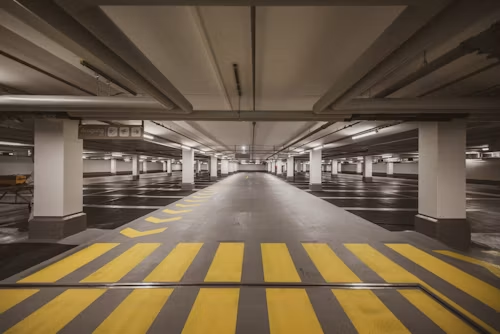
Parking guidance system
Helps drivers find a free space inside the car park, and shows operators how every bay is used.
Includes sensors, LED bay indicators, directional displays, counters and occupancy software.
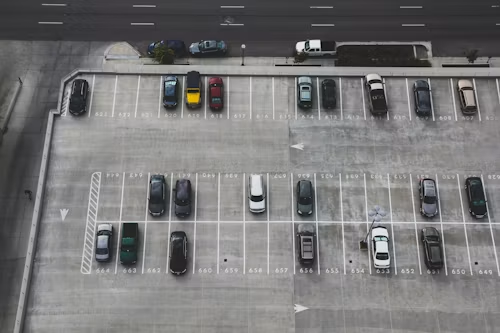
Parking management system
Controls who enters, how long they stay and what they pay.
Includes boom barriers, ticket dispensers, pay stations, ANPR and access control.
ASG Systems supplies both, so the barrier that lets a car in and the display that guides it to a bay run as one system. See also our vehicle access control and CCTV installation solutions.
How we deliver your parking guidance system
One team from the first visit to long-term support, with a clear plan and a detailed quotation before work starts.
- 01
Site survey
We visit your site and map levels, bays, ramps, ceiling heights, lighting and traffic flow, and note any existing barriers or CCTV.
- 02
System design
We choose the detection technology, plan sensor, sign and cable positions, and share a clear layout with a detailed quotation.
- 03
Installation
Our engineers install sensors, indicators, displays and cabling in phases, so your car park can stay open while we work.
- 04
Commissioning and training
We test every bay and every sign, set up zones and reports, and train your staff on the software.
- 05
Support and maintenance
Preventive maintenance visits and a responsive support team keep the system accurate year after year.
Why choose ASG Systems for parking guidance
A Pakistani security and automation company with the engineering depth of an international integrator.
Experience since 1997
Decades of security, access control and automation projects for homes, businesses and institutions across Pakistan.
Trusted by high-security sites
Airports, government and commercial clients rely on our systems where downtime is not an option.
One integrated partner
Parking guidance, parking management, barriers, ANPR and CCTV from one team and one point of contact.
Built for local conditions
Hardware and installation practices chosen for heat, dust and power-backup needs in Pakistani car parks.
Parking guidance installation across Pakistan
We design, install and support parking guidance systems in Lahore, Karachi, Islamabad, Rawalpindi, Faisalabad, Multan, Peshawar, Sialkot, Gujranwala, Hyderabad and Quetta, and take on projects anywhere in Pakistan.
Parking guidance system FAQs
Answers to the questions we hear most from mall owners, hospital administrators and facility managers.
What is a parking guidance system?
A parking guidance system uses sensors, LED bay indicators, directional displays and software to detect free parking spaces in real time and guide drivers to them. It cuts search time, eases congestion inside the car park and gives operators live occupancy data.
How much does a parking guidance system cost in Pakistan?
The cost depends on the number of bays and levels, the detection technology (ultrasonic or camera), the number of directional displays, cabling distances and any integration with parking management or CCTV. ASG Systems provides a detailed quotation after a free site survey.
Which is better, ultrasonic or camera-based parking sensors?
Ultrasonic sensors are cost-effective and very reliable for covered and basement car parks, with one sensor per bay. Camera-based detection covers several bays per unit and adds number plate recognition, video and find-my-car features, which suits malls, airports and premium sites. Many projects combine both.
Can a parking guidance system be installed in an existing car park?
Yes. Sensors, LED indicators and displays are mounted on ceilings or walls and connected with low-voltage cabling, so existing basements and multi-level car parks can be upgraded without major civil work. Installation is planned in phases to keep the car park in use.
Does parking guidance work in open-air car parks?
Yes. For surface and open-air parking, pole-mounted camera detection and weather-rated LED displays at entrances and junctions are typically used to show availability zone by zone.
Will the system keep working during load shedding?
Sensors, controllers and displays use little power. We recommend connecting them to UPS or generator backup so guidance continues during outages. When power returns, the sensors detect every bay again automatically.
Can it integrate with our parking management system, barriers and CCTV?
Yes. Parking guidance software can share data with ticketing and pay stations, boom barriers, ANPR cameras, CCTV and building management systems, so entry control and in-car-park guidance work as one system.
How long does installation take?
A single-level car park can often be completed within days, while large multi-level sites usually take a few weeks. We confirm the timeline in the project plan after the site survey.
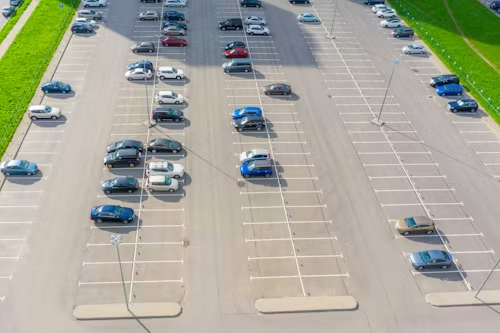
Built for car parks of every size
From a single row of reserved bays to open-air lots with hundreds of spaces, we plan detection and guidance around how your site is really used.


Ready to Guide Every Driver to a Free Space?
Book a free parking site survey with ASG Systems. Our engineers will map your levels, bays and traffic flow, and design a parking guidance system built for your facility.
