
Walls alone no longer stop determined intruders. Across Pakistan, homeowners, factories, schools and government sites are adding an electric fence on top of their boundary walls because it does something a wall cannot: it actively deters, detects and alerts. But not every electric fence is the same. The energizer, the number of zones, the wire quality, the earthing and the installation work decide whether a fence protects you for years or becomes a constant headache. This guide explains how electric fencing works, what to look for, and how to plan the right system, based on what ASG Systems has learned installing perimeter security in Pakistan since 1997.
What is an electric security fence?
An electric security fence is a set of high-tensile wires mounted on insulated brackets, usually on top of a boundary wall or as a free-standing fence. An energizer sends short, high-voltage pulses through the wires, roughly once per second. Each pulse lasts only a fraction of a second, so anyone who touches the fence receives a sharp, memorable shock that makes them let go and step back. The fence is designed to deter and alarm, not to cause lasting harm.
A modern security fence does three jobs at once:
- Deter: visible wires and warning signs make most intruders choose an easier target.
- Delay: the shock and the physical wires slow down anyone trying to climb over.
- Detect and alert: if a wire is cut, shorted or earthed, the energizer raises an alarm through a siren, a guard-room panel or a mobile notification.
The main parts of an electric fence system
| Component | What it does | What to check |
|---|---|---|
| Energizer | Generates the high-voltage pulse and monitors the fence | Genuine brand, compliance with IEC 60335-2-76, alarm outputs, number of zones |
| Fence wire | Carries the pulse along the perimeter | High-tensile, corrosion-resistant wire (stainless or aluminium alloy) that stays tight in Pakistani heat |
| Brackets and insulators | Hold the wires away from the wall and from each other | UV-stabilised insulators that will not crack in summer sun |
| Earth system | Completes the circuit and makes the shock effective | Proper earth spikes driven deep into the ground and tested |
| Battery backup | Keeps the fence live during load-shedding | Battery sized for your local outage hours |
| Warning signs | Legal and safety notice to the public | Clearly visible signs at regular intervals along the fence |
| Siren / alarm panel / app | Tells you when the fence is attacked | Integration with your guard room, CCTV or mobile phone |
How to choose the right energizer
The energizer is the heart of the system, so it deserves the most attention. Three things matter most.
1. Energy (joules) and fence length
Energizers are rated in joules. A higher-rated energizer can drive a longer fence with more strands and still deliver an effective pulse when the fence is under load, for example when plants or dust touch the wires. A small house boundary needs far less than a factory or campus perimeter running for kilometres. International safety standards limit how much energy each pulse may deliver to a person, which is why genuine, certified energizers are important: they are designed to be effective and safe at the same time.
2. Number of zones
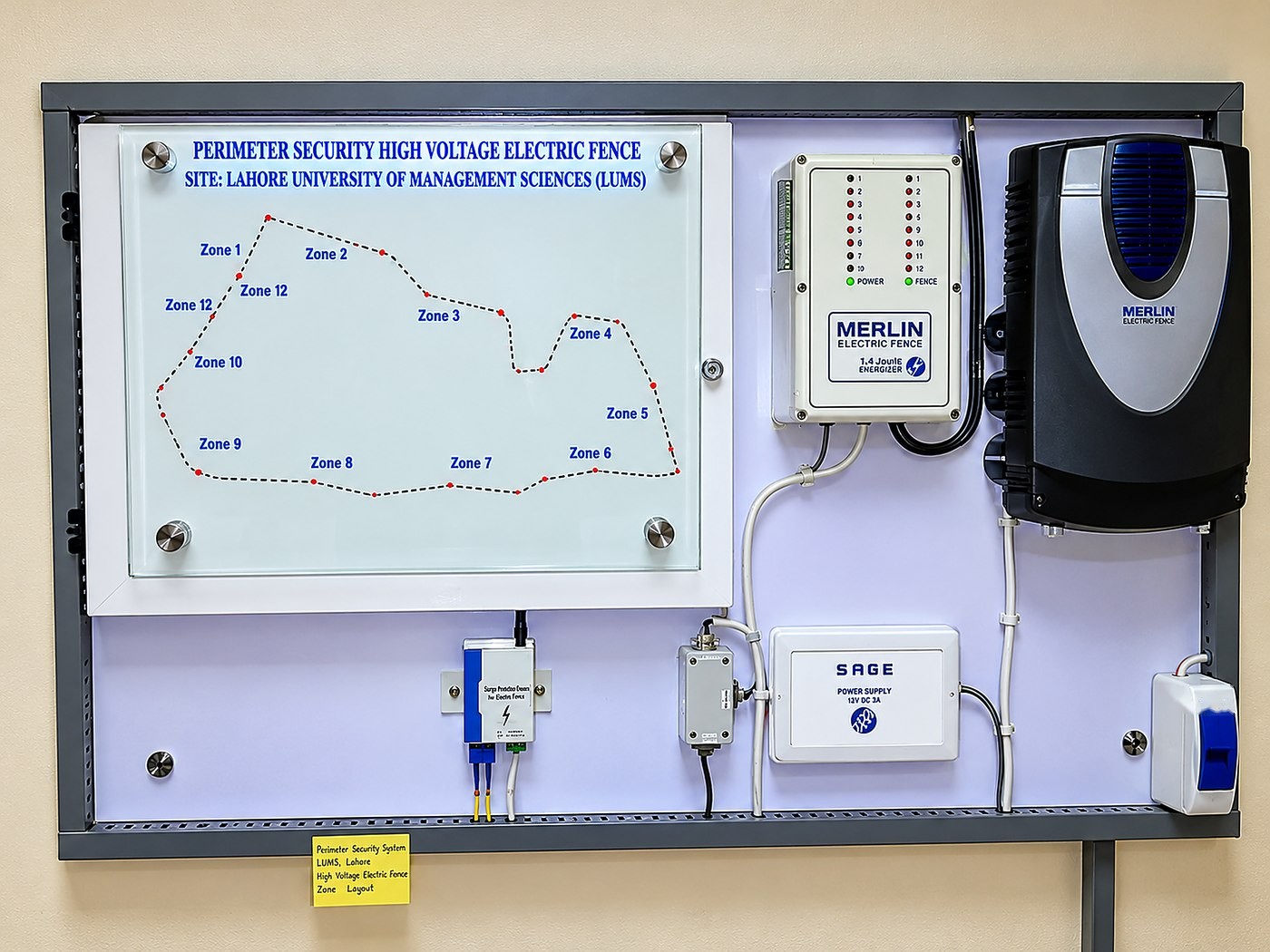
A zone is a section of fence that the energizer monitors separately. With a single zone, an alarm tells you only that something happened somewhere on the fence. With multiple zones, your guards know exactly which side of the property to check. For large sites this makes a huge difference to response time. At LUMS, for example, ASG Systems divided a 2.54 km perimeter into 12 monitored zones connected to a central zone panel.
3. Monitoring and alarm features
Look for energizers that detect a cut wire, a short circuit and a low-voltage condition, and that can trigger a siren, a strobe, a GSM or app alert, or a CCTV camera. For homes, a simple siren plus a mobile alert is often enough. For industrial and government sites, the fence should report to a guard room or security operations centre.
Electric fence for homes vs. factories vs. high-security sites
| Site type | Typical setup | Key priorities |
|---|---|---|
| Homes and farmhouses | Wall-top fence, 4 to 8 strands, one or two zones, siren and battery backup | Neat appearance, child and pet safety, works during load-shedding |
| Factories, warehouses and schools | Longer wall-top or free-standing fence, several zones, guard-room alarm panel | Zone-wise alarms, durability, low maintenance, integration with CCTV |
| Banks, government and critical sites | Multi-zone high-voltage fence, often combined with intrusion detection, cameras and lighting | Layered security, 24/7 monitoring, fast response, compliance and documentation |
For the most sensitive sites, an electric fence works best as one layer of a complete Perimeter Intrusion Detection System (PIDS), together with fence or buried sensors, thermal cameras and perimeter lighting.
What decides the cost of an electric fence in Pakistan
There is no single price for an electric fence, because every perimeter is different. These are the factors that decide the final quotation:
- Perimeter length: the total running metres of wall or fence to protect.
- Number of strands: more strands mean more wire, insulators and labour, and a harder fence to climb.
- Energizer brand and rating: genuine international brands cost more but last longer and are safer than clones.
- Number of zones: each extra zone adds monitoring hardware but improves alarm accuracy.
- Wall condition: uneven or weak walls may need extra brackets or repair work.
- Backup and alerts: battery size, siren, GSM or app alerts and guard-room panels.
- Integration: linking the fence with CCTV, lighting or a control room adds value and cost.
The cheapest quote is rarely the cheapest fence. Clone energizers and low-grade wire often fail within a year or two, and a fence that is constantly down gives a false sense of security. Ask every installer exactly which energizer brand, wire type and earthing method they will use.
Safety and installation best practices
A well-designed electric fence is safe for the public and effective against intruders. International guidance on electrified security fences, such as the requirements based on IEC 60335-2-76, highlights a few practices that every good installation should follow:
- Use only one energizer per fence circuit, and keep separate fences properly spaced apart.
- Install clear, durable warning signs at regular intervals along the fence, facing anyone who might touch it.
- Do not combine electric fence wires with barbed wire or razor wire, which can trap a person.
- Run the high-voltage leads in proper insulated cable and conduit.
- Install a deep, tested earth system so the fence works reliably in dry summer soil.
- Keep plants and branches trimmed away from the wires to avoid false alarms and power loss.
Real projects: electric fencing by ASG Systems
- LUMS, Lahore: 2.54 km high-voltage electric fence in 12 monitored zones with a central zone panel and Merlin energizer.
- Lahore School of Economics: 1.8 km perimeter electric fence around the campus boundary, with energizer and monitoring equipment.
- State Bank of Pakistan, Islamabad: high-voltage perimeter electric fence adding a continuous deterrent along a sensitive boundary.
- Jalal Sons stores: security and automation, including electric fences, across store locations in two phases.
Maintenance checklist
- Check the energizer display or app daily for alarms and fence voltage.
- Walk the fence every month to look for loose wires, broken insulators or plants touching the strands.
- Test the battery backup before summer load-shedding season.
- Have a professional service visit at least once or twice a year to test earthing, voltage and alarm outputs.
Frequently asked questions
Is an electric fence safe for children and pets?
A certified energizer delivers short, limited pulses designed to deter rather than injure. With correct installation height, warning signs and a genuine energizer, an electric security fence is a safe and widely used deterrent. Never use homemade or clone energizers.
Does an electric fence work during load-shedding?
Yes, if it has a battery backup. Most quality energizers draw very little power, so a correctly sized battery keeps the fence live through typical outages.
Can the fence alert me on my phone?
Yes. Energizers can be connected to GSM or app-based alarm modules, so you receive an alert when the fence is cut, shorted or tampered with.
How long does installation take?
A typical home boundary can often be completed in a day or two. Large industrial or campus perimeters are planned zone by zone and take longer, depending on length and site conditions.
Get a free electric fence survey
ASG Systems designs, installs and services electric fencing for homes, businesses and high-security sites across Pakistan, with offices in Lahore, Islamabad and Karachi. Tell us about your property and we will recommend the right energizer, zoning and backup for your perimeter. Explore our electric fence and perimeter security solutions, or request a free quote today. You can also call or WhatsApp us on +92-301-8451902.
