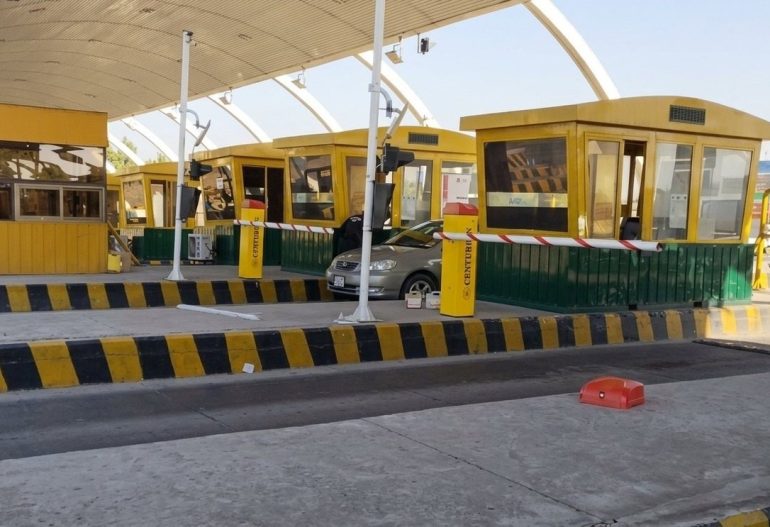
A boom barrier controls traffic, but it will not stop a car that is driven at it. For government offices, military gates, airports, banks and data centres, the entrance needs a hard stop: a hydraulic road blocker. When buyers search for the hydraulic road blocker price in Pakistan, they find very different figures for machines that look the same. This guide explains the types of road blocker, the factors that really decide the cost, and how to choose the right model for your site.
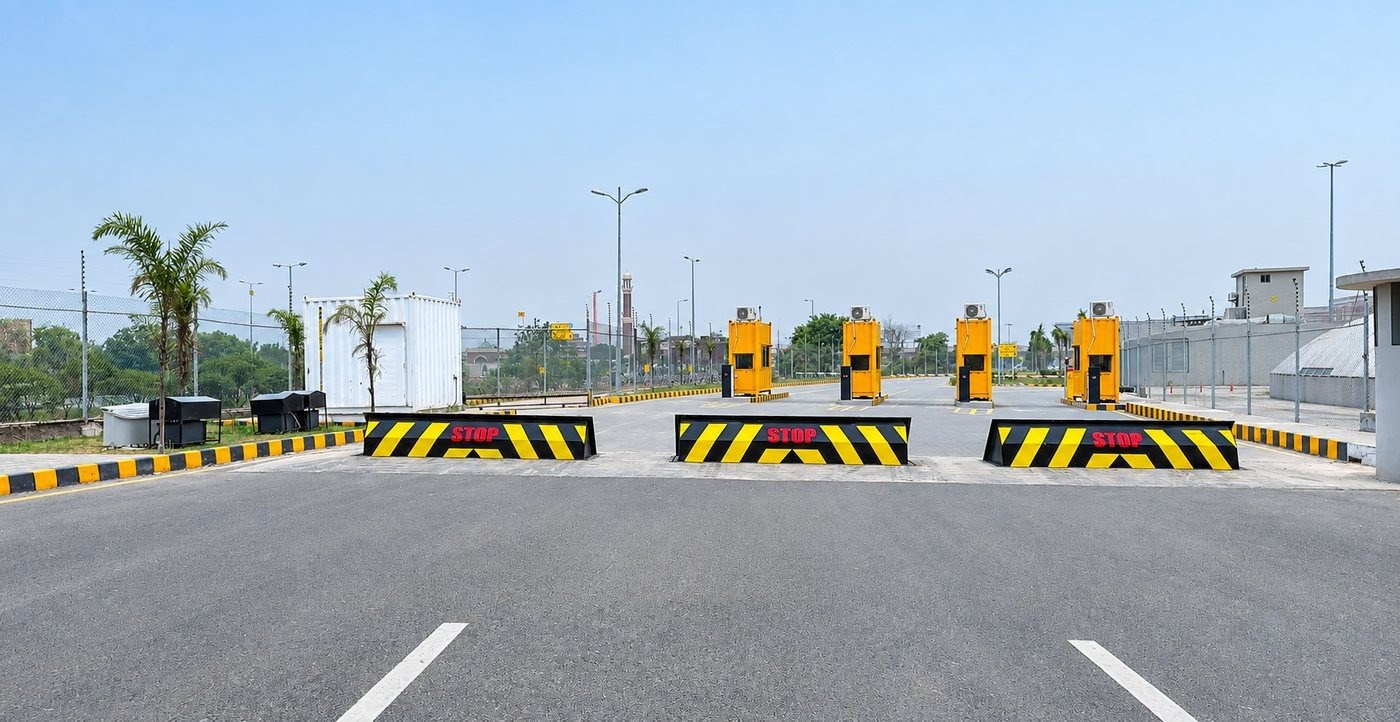
What is a hydraulic road blocker?
A road blocker, also called a wedge barrier, is a heavy steel plate that rises out of the road to physically stop a vehicle. When an authorised vehicle arrives, a hydraulic power unit lowers the plate flat into the road so the vehicle can drive over it. After the vehicle passes, the plate rises again and the lane is sealed.
This is the key difference from a boom barrier. A barrier arm manages everyday traffic; a road blocker is designed to resist a vehicle that tries to force its way in. On most high-security gates the two are used together: the barrier handles routine entry and the blocker is the hard stop behind it.
Main parts of a road blocker system
| Component | What it does |
|---|---|
| Blocker plate | Heavy steel wedge with warning stripes that rises to close the lane |
| Foundation frame | Steel frame set in concrete; surface, shallow or deep mounted |
| Hydraulic power unit | Pump and cylinders that raise and lower the plate |
| Controller | Links the blocker to readers, loops, lights and the guard room panel |
| Traffic lights and markings | Show drivers clearly when the lane is closed or open |
| Emergency button | Raises the blocker in seconds when a threat is detected |
Types of hydraulic road blocker
1. Surface-mounted road blockers
Bolted on top of the road with almost no excavation. They install quickly and suit sites where digging is difficult, temporary checkpoints, or roads with underground services. Vehicles drive over a low ramp when the blocker is down.
2. Shallow-mount road blockers
Set in a shallow pit so the plate lies flush with the road when lowered. They give a smooth drive-over with much less civil work than a deep foundation, and are a common choice for offices, banks and campuses.
3. Deep-mount road blockers
Installed in a deeper reinforced foundation for maximum strength. They are used at permanent high-threat entrances where heavy vehicles must be stopped, such as government buildings, military sites and airports.
4. Crash-rated road blockers
Designed and tested to stop a vehicle of a given weight at a given speed, usually to international standards such as PAS 68, IWA 14 or ASTM F2656. A crash rating is what turns a road blocker from a deterrent into proven protection, and it is often required for embassies and critical national sites.
5. Emergency fast operation (EFO)
An EFO system raises the blocker in a few seconds when the guard presses the emergency button. It is used where a vehicle threat must be stopped immediately, for example at the main gate of a sensitive facility.
Hydraulic road blocker price in Pakistan: what decides the cost
There is no single price for a road blocker, because the cost is driven by the threat level and the site. These are the factors that make the biggest difference:
| Cost factor | Why it changes the price |
|---|---|
| Crash rating | A certified crash-rated blocker uses more steel, stronger foundations and testing; it costs much more than a non-rated model |
| Lane width | Wider lanes need a longer plate, more hydraulics and a bigger foundation |
| Mounting type | Deep-mount needs the most excavation and concrete; surface-mount needs the least civil work |
| Speed and EFO | Emergency fast operation needs a stronger hydraulic unit and controls |
| Number of lanes | Each lane needs its own blocker, loops and lights; controls can be shared |
| Integration | RFID, number plate recognition, boom barriers, intercom and CCTV add equipment and programming |
| Power backup | UPS or a manual hand pump keeps the gate working during load-shedding |
| Civil and drainage work | Pits need drainage so rainwater does not damage the hydraulics; ground conditions affect this |
| Brand and warranty | Proven brands, local spare parts and an annual maintenance plan cost more but cut downtime |
Because of these factors, two quotations can differ a lot. When comparing offers, check that both include the same crash rating, mounting type, civil work, safety loops, traffic lights, backup and installation. A cheaper quote often leaves out the foundation work or the safety devices.
Safety features you should insist on
- Vehicle detection loops so the blocker can never rise under a car and to confirm when a vehicle has passed
- Traffic lights and warning stripes so drivers see the blocker day and night
- Manual hand pump to lower the blocker during a power failure
- Emergency fast operation where the threat level needs it
- Proper drainage in the pit to protect the hydraulic unit during the monsoon
Road blocker, bollards or boom barrier?
| Solution | Best for | Security level |
|---|---|---|
| Boom barrier | Fast lane control at societies, car parks, offices, toll plazas | Standard |
| Bollards | Stopping vehicles while letting people walk through (building fronts, plazas, embassies) | Standard to high |
| Hydraulic road blocker | Physically stopping a vehicle at a gate (government, military, airports, data centres) | High |
Many high-security entrances use all three: a boom barrier for everyday traffic, a road blocker as the hard stop and bollards to protect the pedestrian side. For barrier costs, see our boom barrier price guide.
Real road blocker projects by ASG Systems
- Allama Iqbal International Airport, Lahore: 4 road blockers and 8 traffic barriers at the airport checkpoints, with parking management for 3,500 cars.
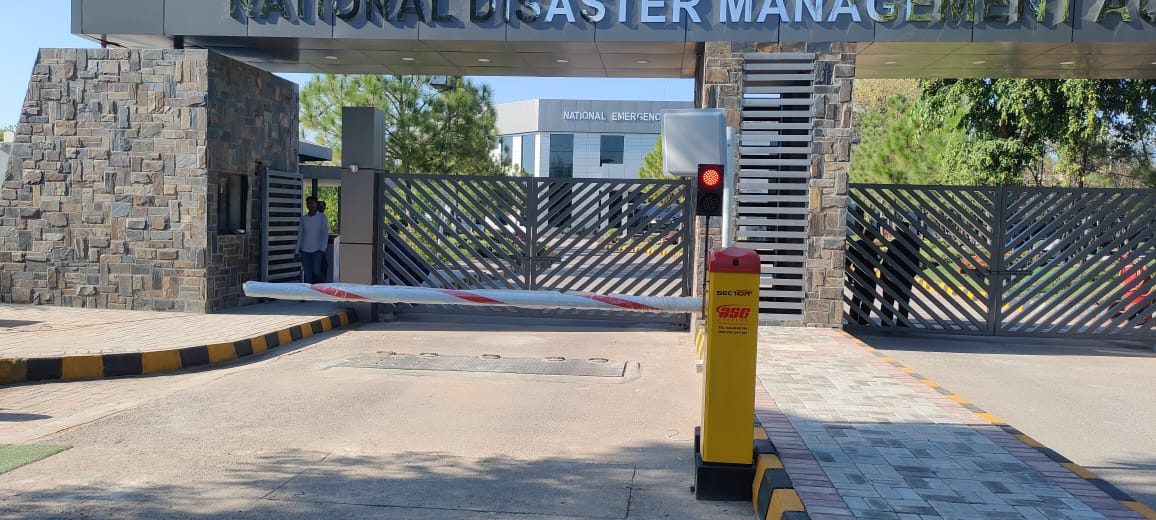
- NDMA Headquarters, Islamabad: a hydraulic road blocker working together with a boom barrier at the main gate, with pedestrian access control.
How to choose the right road blocker
- Start with the threat: is the goal to deter, or to stop a vehicle at speed? This decides whether you need a crash rating.
- Measure the lane width and check what is under the road before choosing deep, shallow or surface mounting.
- Decide how vehicles will be identified: guard button, RFID tag or number plate recognition.
- Plan power backup and drainage from the start.
- Ask for a site survey and a written scope so quotations can be compared fairly.
Frequently asked questions
What is the price of a hydraulic road blocker in Pakistan?
It depends mainly on the crash rating, lane width, mounting type, emergency operation and the civil work needed. A non-rated surface-mounted blocker for one lane costs far less than a crash-rated deep-mount blocker with EFO. A site survey is the only way to give an accurate price.
What is the difference between a road blocker and a boom barrier?
A boom barrier is an arm that controls traffic; it can be driven through. A road blocker is a steel plate that rises from the road and physically stops a vehicle, so it is used where security matters most.
Does a road blocker work during load-shedding?
Yes, if it is designed for it. A UPS keeps it running for a period, and a manual hand pump lets the guard lower the blocker if power is lost.
How long does installation take?
Surface-mounted blockers can be installed in a short time. Shallow and deep-mount blockers need excavation, concrete curing and drainage, so they take longer and are best planned with the civil works.
Get a free site survey
ASG Systems has supplied, installed and maintained security and automation systems in Pakistan since 1997, including road blockers at national-level sites. Tell us about your entrance and we will recommend the right blocker and send a clear quotation. Contact ASG Systems or message us on WhatsApp for a free site survey.